Article: Understanding My Process Through Oystermouth Castle
Understanding My Process Through Oystermouth Castle
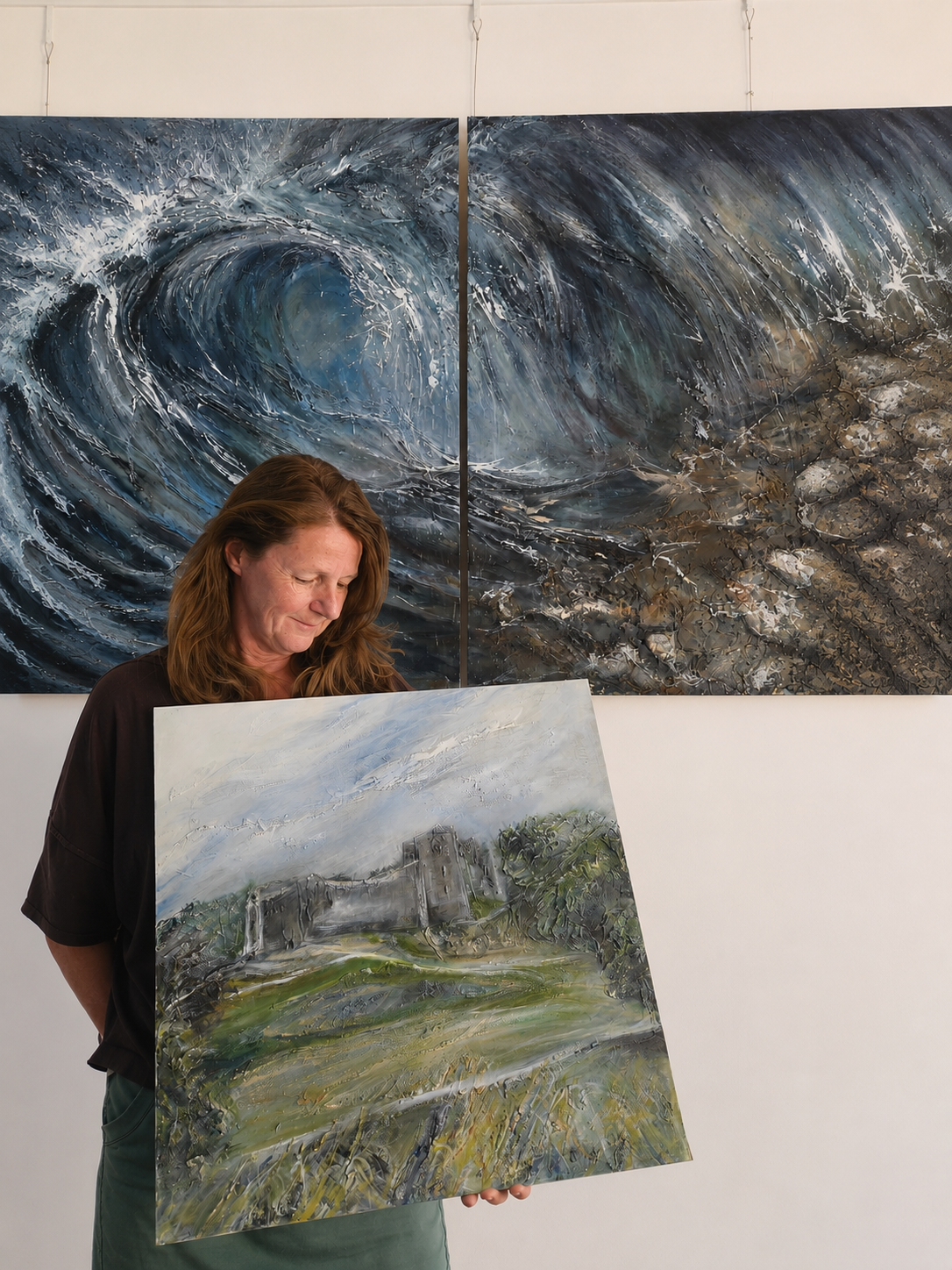
My recent painting of Oystermouth Castle gave me the perfect opportunity to share something that I am often asked about.
Over the years, I have been asked how my paintings begin and, in particular, how I achieve the texture that people enjoy so much. More recently, many responses to a newsletter I sent asked to hear more about my process and the thinking behind my work. Rather than simply explaining it in conversation, I thought I'd use this painting to open the studio door a little wider and share how my process has evolved into the way I work today.
There was another reason for choosing Oystermouth Castle.
I painted it in preparation for taking part as a Wildcard for Landscape Artist of the Year at Margam Castle. Although I regularly paint and make studies outside, I usually create much larger works in the studio, where my paintings begin with plaster before I ever reach for paint. Before painting at Margam, I wanted to discover whether my complete process could successfully be taken outside.
Oystermouth Castle was the perfect place to find out.
Having lived in its shadow for the past seven years, I know it well. I've walked my dog through the grounds countless times and even enjoyed festivals held there. Long before I arrived with my easel, I already knew exactly where I wanted to work.
I also knew something else.
I need space when I'm creating.
I'm not someone who finds it easy to paint while being closely watched. I need to settle into what I'm looking at, to concentrate fully and allow the painting to develop naturally. If that concentration is broken too often, it can be surprisingly difficult to return to the same creative place.
That was another reason for this exercise. I knew that at Landscape Artist of the Year there would be visitors walking around the Wildcards throughout the day, so I wanted to prepare myself mentally as much as practically.
Once I'd found my spot, I unpacked my materials and simply sat for a while.
The first mark didn't happen immediately.
It rarely does.
Looking is an important part of painting.
As an art teacher, I often encouraged students to spend more time looking at their subject than at their paper. There's a good reason for that. Drawing and painting are responses to observation. If your eyes remain connected to the subject, your hand naturally begins to respond with greater honesty.
That remains fundamental to the way I work.
Before I applied any plaster, I spent time absorbing the landscape in front of me. It wasn't simply the castle that interested me. It was the sculptural sweep of the land leading towards it and the way the castle nestles so naturally within it.
What interested me most wasn't simply the castle itself. It was the relationship between the castle and the land. The castle sits above the landscape almost like a crown, yet without the sweep of the land beneath it something essential would be lost. For me they are inseparable. The landscape gathers around the castle almost protectively, and that relationship became every bit as important to the painting as the castle itself.
That sweep became the beginning of the painting.
As I applied the plaster, I spent more time looking at the landscape than I did the panel itself. My hand followed the rise and fall of the ground almost instinctively, stroking the plaster in the same direction as the land before me.
It wasn't about copying the contours precisely.
It was about allowing the landscape to begin living within the painting.
The use of plaster in my work isn't something that happened by chance.
It has its roots in sculpture.
My degree was in Sculpture, and it was there that I first fell in love with plaster as a material. At the time I was creating full sculptural pieces, sometimes built around an armature. One particular sculpture, depicting three figures bound together back-to-back, was selected as the winning design for a commissioned foyer installation. I still remember the excitement of hearing it had been chosen.
Although my practice has evolved from sculpture into painting, that sculptural way of thinking has never left me.
The plaster remains fundamental.
For me, it is important not to have a finished image fixed in my mind before I begin. Trying to work towards an already completed picture can restrict the freedom to respond to what is happening in front of me. A painting needs room to grow, to evolve and sometimes even to surprise me.
Paul Klee famously spoke of "taking a line for a walk". I've always liked that thought. It captures something of the freedom that exists within the creative process.
Once I begin to work in paint, another stage of the conversation starts.
Thin washes settle naturally into the crevices while the brush catches the raised surfaces. The plaster influences how the paint behaves and the paint reveals qualities within the plaster that weren't obvious before. Neither dominates the other. They work together.
Over many years, this has become fundamental to the way I work.
The plaster provides the structure of the painting.
Colour brings light, atmosphere and feeling.
I've often described the plaster as the bones of the work. If the plaster provides the bones, then colour gives the painting its complexion, its tone and ultimately its presence. Together they create something that neither could achieve alone.
When I paint, I have no desire to describe every stone, every window or every architectural detail.
My interest lies elsewhere.
I'm looking for the essence of the subject. Its character. Its presence. The way it occupies the landscape.
The detail is there, but often as an impression rather than a description. I want to leave space for the viewer to complete part of the journey themselves.
Standing before Oystermouth Castle, I wasn't looking at a building sitting on a hill.
I was looking at one complete landscape.
The castle is undoubtedly resilient, strong and commanding, yet it doesn't dominate in an aggressive way. It belongs exactly where it stands. The land beneath it is just as important as the castle itself. Without that sculptural sweep leading towards it, something essential would be missing.
For me, they are one.
Working with plaster is a physical process.
As it begins to firm, it becomes beautifully workable. I use my hands as much as my tools, adding, removing, sweeping and carving into the surface as the painting develops.
I love this stage.
The plaster becomes another language through which I can communicate.
On larger paintings, I've often described the process as almost being like a performance. The energy comes from my whole body rather than simply from my hand.
The wave doesn't simply represent movement.
It becomes movement.
The landscape doesn't simply inspire the painting.
It becomes part of it.
People occasionally ask how I know when a painting is finished.
For me, there comes a point where it has simply said enough.
Any further marks would become colouring in rather than discovery.
That is the moment I stop.
Not because the journey has ended, but because that particular conversation has reached its natural conclusion.
Every painting becomes another step forward.
Finally, what do I hope people experience when they stand in front of one of my paintings?
It is connection.
I don't simply want someone to recognise Oystermouth Castle.
I hope they feel drawn towards it.
Perhaps they'll want to visit.
Perhaps they'll see the relationship between the castle and the land a little differently.
Perhaps they'll simply pause for a moment and feel the atmosphere of the place.
A photograph can show us what somewhere looks like.
A painting can communicate what it feels like to stand there.
That, for me, is the real purpose of painting.
Thank you for taking the time to read this.
Many responses to my recent newsletter asked to hear more about my process, so I hope this has offered a little insight into the thinking behind one of my paintings.
If you ever find yourself in Mumbles, you're always very welcome to call into the gallery. I'd be delighted to show you the Oystermouth Castle painting in person and talk more about my work, my process and the stories behind the paintings.
Until next time,
Jo